Remembering
Michael Levin (1940-2025)

L-R: Michael Levin, Lowell Hawkinson, Ed Fredkin. 16 August 2016. Courtesy of Mark David.

Michael I. Levin died on 14 August 2025. He played important roles in the original LISP 1.5 project and the follow-on LISP 2 project. Later he cofounded Gensym, which developed a real-time expert system. He had a lifelong interest in teaching, perhaps influenced by his parents, who were both school teachers. This account was pieced together from my email connections with him between 2005 and 2017, my research on the LISP 1.5 and LISP 2 projects, a 2019 interview by his cousin Alan Kadin, and a 2009 resume. It only covers Levin’s professional career, although an important part of his life was following the teaching of Chögyam Trungpa.

Levin was born in Paterson, New Jersey and grew up in nearby Totowa. He did well in school and applied to five colleges, choosing M.I.T. and enrolling in fall 1958. He majored in mathematics but was attracted to computer science, taking a graduate course by Marvin Minsky in his sophomore year. Minsky proposed a problem—providing an effective definition of “Random Sequence”—that engaged Levin and apparently provided a topic for his undergraduate thesis. He also coauthored a technical report with Minsky and Roland Silver entitled “On the effective definition of ‘Random sequence'” (AI Memo 36 revised; undated).

Apparently even before he graduated (in 1962), Levin had joined McCarthy’s Lisp project. His first publication was “Arithmetic in LISP 1.5” (AI Memo 24, April 1961), which noted it was an excerpt from the upcoming LISP 1.5 Programmer’s Manual. A version of that manual was released on July 14, 1961; its preface notes “This manual was written by Michael Levin starting from the LISP I Programmer’s Manual by Phyllis Fox.” But the final August 17, 1962 version simply states “This manual was written by Michael I. Levin.” There was another significant change between the two versions: the former said “The compiler was written by Robert Brayton with the assistance of David Park” while the latter said “The compiler and assembler were written by Timothy P. Hart and Michael I. Levin. An earlier compiler was written by Robert Brayton.” Apparently Brayton’s compiler, which was written in assembly language, was more difficult to maintain than the Hart-Levin compiler, which was written in Lisp (see “The New Compiler”, AI Memo 39) and could compile itself (after being “bootstrapped” using the interpreter). In 2013, he mentioned to me that one of his contributions to the compiler was converting a class of tail-recursive calls to iteration, a transformation that became much more well known in the 1970s. See this recent explanation of how Levin’s PROGITER function worked.

In 1962 McCarthy left M.I.T. but continued his work at Bolt Beranek & Newman (BBN); Levin joined him there. In 1963 McCarthy moved to Stanford to found an AI Laboratory. Levin may have briefly worked with McCarthy there, but by 1963 he was at M.I.T. working on a system for proof checking, as evidenced by his report “Primitive Recursion” (AI Memo 55, July 1963). Also he and his colleague Tim Hart wrote “LISP Exercises” (AI Memo 64, January 1964), intended to be used with the first chapter of The LISP 1.5 Programmer’s Manual. Perhaps they were teaching a course? Later in 1964, as the hardware for M.I.T.’s Multics operating system was being designed, Levin wrote: “Proposed Instructions on the GE 635 for List Processing and Push Down Stacks” (AI Memo 72, September 1964). Tom Van Vleck, creator of Multicians.org, told me:

I was at a big meeting where the 645 was presented to many users of the Project MAC facilities, mostly CTSS at the time. Corby led the presentation and multiple others covered various aspects. Ted Glaser talked about the associative memory and paging.

Many folks had questions. Mike raised the issues in his memo. … Ted Glaser responded, and Mike responded to that, and it was clear that the issue had many details that would have to be resolved. Mike kept asking for commitments that the presenters weren’t ready to talk about. Finally, Ted said, “We can’t do it that way, it would overload the busses.”

It was possible that Ted was making this up to end the discussion… but Ted was incredibly smart, and thought faster than anybody, and who was going to argue with a blind genius?

In any event Levin’s LISP instructions were not added to the 645.

Around this time discussions at M.I.T. and Stanford began on a follow-on language, eventually named LISP 2. Looking back in 1978, McCarthy noted:

As a programming language LISP had many limitations. Some of the most evident in the early 1960s were ultra-slow numerical computation, inability to represent objects by blocks of registers and garbage collect the blocks, and lack of a good system for input-output of symbolic expressions in conventional notations. All these problems and others were to be fixed in LISP 2.

The project expanded beyond what either of the AI labs could take on and moved to the Systems Development Corporation (SDC) in Santa Monica, California. SDC was experienced at software development, but not at Lisp, so Information International, Inc. (III) was brought in as a subcontractor. III, founded by Ed Fredkin, employed a number of experienced M.I.T. Lisp programmers, including Levin and Lowell Hawkinson.

One defining feature of LISP 2 was a syntax based on Algol 60, designed by Levin: “Syntax of the New Language” (AI Memo 68, May 1964). But by 2012, he told me:

An important idea for LISP II, which I emphasized from the beginning, but which was never implemented, and was eventually shown not to be needed, was the source language translator. This had its roots as a pedagogical device used by John McCarthy to show that there is a formal analogy between LISP and Gödel numbering. It was important to Gödel’s proof of the incompleteness of arithmetic to show that a language of logical theorems and proofs could be mapped into the domain of non-negative integers. McCarthy wanted to emphasize that LISP had the same theoretical foundation as Gödel’s proof, only with the difference that the mapping was easy and intuitive rather than being humanly intractable.

Although Levin changed his mind about the importance, I think it had an impact through the paper “The LISP 2 Programming Language and System,” (FJCC 1966) planting the idea of Algol-like languages with dynamic data structures.

Levin was also thinking about the runtime requirements for the new language at this time: “New Language Storage Conventions” (AI Memo 69, May 1964). Around this time, it appears he moved to Santa Monica to work more closely with the SDC team, and wrote a series of technical reports probably best studied in context at this web site dedicated to the project.

Levin returned to M.I.T. in 1965, apparently as an instructor, thinking about mathematical logic: “Topics in Model Theory” (AI Memo 78, May 1965; revised as AI Memo 92, January 1966). His resume notes: “Developed and taught graduate course entitled Mathematical Logic for Computer Scientists“. The resultant book was published as an M.I.T. LCS report (TR 131, June 1974). The book caught the eye of famous logician Stephen Cole Kleene, who noted in a footnote of a 1978 paper:

It was pointed out to me in Oslo on June 13, 1977 by David MacQueen that computer scientists have developed the theory of working with the expressions of a given formal language as a generalized arithmetic to the extent that it is not necessary to reduce the language to the simple arithmetic of the natural numbers by a Gödel numbering or indexing. Cf. Levin 1974, Scott 1976. (An early example of generalized arithmetic is in IM § 50.)

(in the interview by Alan Kadin, Levin joked: “During my time at Stanford, I studied a book by Stephen Cole Kleene, Introduction to Metamathematics. As far as I know, I may be the only person who carefully read this entire book.)

In addition to BBN and III, Levin worked for Composition Technology, where he said he implemented the world’s first typesetting program.

In the early 1970s Levin went to Colorado, apparently attracted by the teaching of Chögyam Trungpa. He held several teaching and research positions there, and then in 1982 he became an associate professor of computer science at Acadia University in Nova Scotia.

Returning to Massachusetts in 1984, he joined LISP Machine, Inc. (LMI), one of the two companies that spun out of M.I.T.’s Lisp machine project. Levin designed the inference engine for PICON, LMI’s real-time expert system. By 1986 it became clear to him and several of his colleagues (including Lowell Hawkinson, with whom he’d worked at III) that LMI was failing, so they left and co-founded Gensym. Gensym’s G2 real-time expert system, similar to PICON but with a from-scratch implementation, was very successful for industrial process control. A 1996 initial public offering allowed Levin to finance his later retirement, although he also did consulting work from 1999 to 2004.

John McCarthy had a vision of a programming language for symbolic processing in artificial intelligence. Michael Levin was a central member of the team that turned that vision into a practical implementation. Throughout his career he combined effective engineering with mathematical insights.

This essay benefited from comments by Mark David, Roger Frye, and Alan Kadin. I’m also indebted to Alan for his oral history.
Modula-3

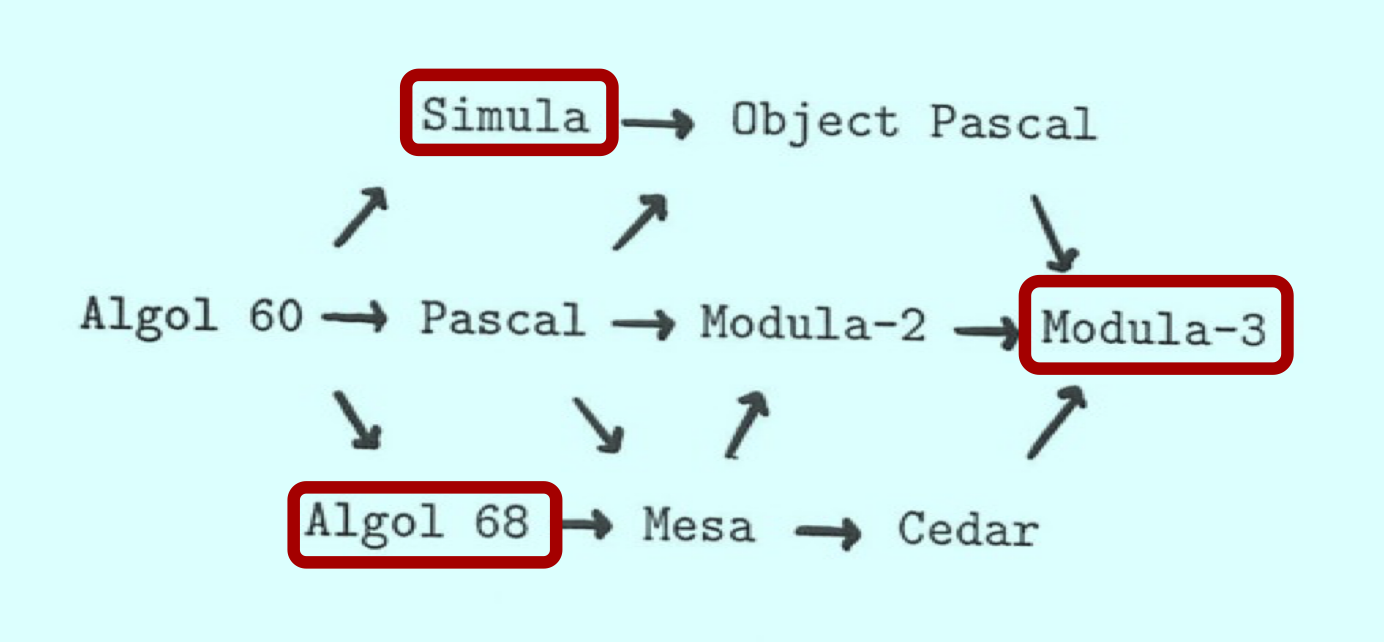
Languages influencing Modula-3, starting with Algol 60

There’s a brand new project at the newly-refurbished Software Preservation Group website: the Modula-3 programming language. Modula-3 sounds like it would have been designed by Niklaus Wirth, but it was actually designed by a committee consisting of Luca Cardelli, Jim Donahue, Mick Jordan, Bill Kalsow, and Greg Nelson, and named Modula-3 with Wirth’s blessing.

The diagram above, drawn by Nelson, gives an idea of its heritage. Mesa, designed at Xerox PARC in the mid 1970s, borrowed many ideas from Pascal, but added modules (with interfaces called DEFINITIONS modules and a module configuration language), exceptions, and threads (called processes, but they shared a single address space). Wirth spent a sabbatical at PARC, and decided to add definition modules to Modula-2. Meanwhile, PARC’s Cedar project extended Mesa with storage safety (via garbage collection) and runtime type determination. Then a core of PARC researchers followed their director Bob Taylor to establish the System Research Center (SRC) at DEC. They couldn’t take Cedar with them (it was proprietary, and ran only on exotic Dorado workstations). Another DEC lab had implemented a Modula-2 compiler, which the SRC people extended with their favorite Cedar Mesa features (exceptions, threads, garbage collection, and runtime type determination), naming the result Modula-2+. The nearby Olivetti Research Center, with other former PARC researchers, adopted this new language too. Seeing the utility of this language, Maurice Wilkes, retired from Cambridge but consulting at DEC and Olivetti, suggested to Wirth that Modula-2+ be revised and standardized as Modula-3. Wirth approved and the committee got to work, ultimately adding two important features, object types and generics; even still, the Modula-3 Report came in at just over 50 pages.

The SRC implementation at first generated C. Later the compiler was restructured with an interface making it fairly easy to substitute different code generators; one that used the back-end of gcc allowed widespread portability. Modula-3 adoption began spreading, facilitated by ftp to distribute source code and email and the comp.lang.modula3 newsgroup to share ideas and experience.

Researchers at SRC switched fairly quickly from Modula-2+ to Modula-3: the former was tied to older hardware, whereas Modula-3’s portability allowed it to run on the latest DEC ALPHA workstations. Projects included window system toolkits, algorithm animation, distributed systems, experimental programming languages, two-view and constraint-based editors, new web browsing paradigms, and program verification. Many of these projects produced libraries that became building blocks for subsequent projects. Researchers at several universities also found it a good base for ambitious projects, including an extensible operating system and an augmented reality system. One small company attempted to commercialize the language. An open-source developer used it to create the system used for many years to distribute FreeBSD source code.

Then Java came along, offering similar features plus “write once, run anywhere”—that plus Sun Microsystem’s marketing effort quickly eclipsed Modula-3. Even at SRC, researchers switched from Modula-3 to Java.

SRC’s system had always been open source, and there were several forks, including the commercial company’s proprietary version (which was later open-sourced). Gradually the forks were merged into two alternative releases, CM3 and PM3, which are both hosted at https://github.com/modula3/. CM3 will run on most modern platforms. Documentation exists, but isn’t always easy to navigate.

My personal interest in Modula-3 began when I worked at SRC and helped develop some of the standard library interfaces and an application. I hope the language will be remembered—and used—for many years to come.

Emacs

In 2016 Lars Brinkhoff emailed:

I have started working on preserving Emacs software:

https://github.com/larsbrinkhoff/emacs-history

Would this be of any interest to the Software Preservation Group?

I immediately agreed: Emacs has a long and honorable history with many implementations, and Lars is a skilled and prolific retro-computerist. By August of this year as I worked to rejuvenate the Software Preservation web site, I noticed that the Emacs page listed the major implementations of Emacs, but did not actually link to the content, whereas Lars’s github repository is filled with source code for a wide variety of implementations and a README that gives detailed provenance. After consulting with Lars, I revised the Software Preservation project to create a presentation layer detailing all the information in his GitHub repository. You can trace the history from the original version written in TECO macros, the Lisp Machine versions, TVmacs in the Architecture Machine Group, Multics Emacs, Prime Emacs, Montgomery Emacs, Gosling Emacs, Zimmerman Emacs, GNU Emacs (and its derivatives), Epsilon, and MicroEMACS.

If you think others should be included, you’ll have to convince Lars.

The Software Preservation Group

Twenty-two years ago the Computer History Museum established an advisory committee (with staff, trustees, and volunteers) to  explore issues of identifying, collecting, preserving, and presenting software. The Museum had just moved into its present quarters; the main Revolution exhibit was still far in the future. But  the previous year, Grady Booch had gotten the ball rolling with a mass email entitled “Preserving classic software products” asking for people’s “top ten list of classic software products.” The replies to that email and the ensuing discussion made it clear that software collection and preservation were worth doing and needed to begin immediately, before more pioneers died and more source code was lost or destroyed.

Monthly meetings of the Software Collection Committee began in November 2003, covering a wide range of topics. Should collection be proactive or reactive? What priorities should guide proactive collecting? (Grady’s compiled top-ten lists provided initial input.) How should software be cataloged? How should it be presented? An initial workshop in October 2003 mostly asked questions, but a follow-up in May 2006 showed off work from CHM and from other organizations and individuals.

While many discussions raged for months, restless folks began “pilot projects” to collect materials from the original IBM 704 FORTRAN project, Doug Engelbart’s NLS/Augment project, and the APL programming language. A web site was set up to present the results of these pilot projects and the monthly meetings. An email list with an archive allowed people who couldn’t attend the meetings to participate in many discussions.

As time passed, interest in software preservation expanded. The Museum opened its Revolution! exhibit in 2011 followed by Make Software: Change the World! in 2017. Its Software History Center centralized and expanded the software-related curatorial staff. Source code releases became a regular occurrence. Work also went on outside the Museum. Software Heritage, founded by INRIA, maintains a replicated repository and populates it by crawling the world’s open-source software “forges” such as GitHub.com. 

At the same time, the committee (renamed Software Preservation Group) lost mindshare: The meetings wound down in 2007, and traffic on the email list tapered down to a standstill by 2017. However, encouraged by the success of my original FORTRAN project, I had continued with a series of projects including LISP and C++. After retiring in 2010 I took on larger projects on ALGOL, Prolog, SETL, and BCPL and smaller ones on GEDANKEN, Mesa, PAL, and Poplar, plus program verification systems AFFIRM and PIVOT. Along the way, a few other people found their way to the Software Preservation Group, and created projects: Interactive C Environments (Wendell R. Pepperdine), Emacs (Lars Brinkhoff), and FOCAL (Bruce Ray).

By 2025, the “Projects” section of the Software Preservation Group web site was still serving a useful purpose, but the overall web site was showing its age: the landing page suggested activities no longer in progress, the underlying Plone content management  system hadn’t been updated in 20 years created a burden on the Museum’s IT group to keep running and backed-up, and the use of a different domain deemphasized the connection to the Museum. Discussions with David Brock and Hansen Hsu of the Museum’s Software History Center led to the idea of rebuilding the web site with static HTML on a subdomain of the Museum’s regular computerhistory.org.

As the author of most of the content, I took on this effort in July 2025. It was fairly easy to convert the project web pages I’d created, but I wasn’t sure what to do with projects created by others that had seen little or no activity for years and decades. I managed to contact the original authors, and worked with them to tidy things up (especially Emacs). I also tracked down materials from the 2003 workshop, almost all the meetings (agendas, minutes, and presentation handouts), and the email archive.

While waiting for word back from the NLS/Augment and APL projects, I couldn’t resist starting a brand-new project: the Modula-3 programming language. That will be the subject of another post.

So please visit the new web site at:

https://softwarepreservation.computerhistory.org/

Most links to the old web site will be automatically redirected. If you see things amiss, let me know.